


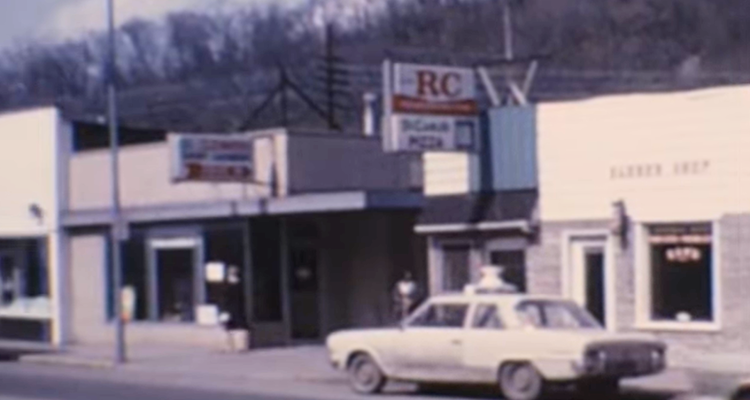
When my father passed away in 2023, I inherited a box of old 8mm and 16mm home movies. I had long been aware of these films; in fact, when I was a teenager we used to play some of the 8mm films on an old projector that my grandparents owned. But we did not have a 16mm projector to play the others. My father would always talk about the “Elm Grove movie” that his brother Bill Elliott (my uncle) had filmed before Interstate 70 was constructed in the late 1960s. We identified which film this was from the batch of 16mm movies, but we never did anything with it. I went away to college in 1990, and that was that. At some point in the 1990s, when I was living elsewhere, my father—unbeknownst to me—loaned this particular movie to an individual who was making a documentary about Elm Grove. And my understanding is that many of its scenes are depicted therein. But I have never seen this film. In any event, when I moved back to Wheeling in 2009, I rediscovered this box of old films and convinced my father that we needed to watch them. He and I found a 16mm projector on eBay and tried to play some of the 16mm films. Before we got to the “Elm Grove movie”, however, the projector began malfunctioning and burning the film. After a few failed efforts to play these movies, we lost interest, and the films returned to the box where they remained until he passed away in 2023. This past holiday season, I decided as a gift to myself that I would send a batch of these movies to Legacybox for proper digitization. (It’s typically an expensive process, but they had some Christmas specials that were too good to pass up.) When these movies were available for download, make no mistake, I played the “Elm Grove movie” first. And it did not disappoint, offering a rare glimpse into the National Road of Wheeling of the late 1960s.
A Few Observations about the Film
While filming begins in the Woodsdale portion of National Road and includes some segments “out the pike”, it’s clear that the focal point of the photographer was Elm Grove. That was no accident. The Elliott side of my family called Elm Grove home from the late 1800s until the mid 1970s. My paternal grandparents lived at 5 Simpson Avenue, which was demolished (after this film was made) for I-70 construction. My grandfather Russell Elliott worked at the Elm Grove Post Office for 40 years, and he made a point to cap off each workday with a visit to the nearby Wakim’s bar for a drink. Towards the end of the film, when the photographer is filming on foot, he zooms in on the Post Office and then pans over to Wakim’s. If this movie had been filmed with audio, there is no doubt my uncle would be making note of his father’s daily pilgrimage with this gesture.
There is also extended footage of a gas station attendant filling up a VW bus with fuel and cleaning its windows. This was Ned Sampson at his family’s American Gas Station, which stood where Main Street Bank branch is today. Ned was my uncle’s best friend at the time. Though I do not know him personally, my understanding is that he is still living in Wheeling. Those under 40 (unless they live in New Jersey) may be surprised to see a full service gas station in action.
Personal Reflections and Legacy
One other note about this film that is probably only interesting to me. My maternal grandfather (Cecil Walter) owned the Elm Grove Auto shop located across National Road from the aforementioned gas station. He and my grandmother Margaret lived on McCurdy Avenue at the time of this filming. But they too lost their home for I-70 construction. By the time I was born in 1971, they had built two additional floors atop their National Road auto shop location to house themselves and my great-grandmother Mary Walter. My understanding is that it was a considerable step down in comfort and style for them. As they got older and their business ultimately failed, they sold that location to what would become Stone Church Video. It is the AT&T store today.
Lastly, I must note that throughout his life, my father would lament to me (and anyone who would listen) the sense of loss he felt about the Elm Grove of his youth because of the I-70 demolition. I used to think he was being overly sentimental, and on more than one occasion I would tell him it’s time to let it go. But as I have gotten older and had time to reflect on the past and on Wheeling generally, he had a point. Progress always comes with a price, and there is no doubt that Wheeling has benefited by having an interstate highway running through it. But neighborhoods like Elm Grove were torn up in ways that have lasting impacts, not only on the community at large, but also on the families impacted. My grandfather Russell had spent decades redoing their Victorian home on Simpson Avenue—including building and installing custom kitchen cabinets. But in 1968 the State used eminent domain and paid them roughly $18,000 for what was supposed to be their forever home. He and my grandmother would move five more times before they died, never finding (or being able to afford) anything as nice. And my grandmother Mildred would tell me that losing their home took something out of her husband that never returned. The grandfather I knew was always very stoic and reserved. Ironically, it is only by watching some of these old 16mm films of him that I can see he was once quite animated and charming.
