

The Great Rewiring
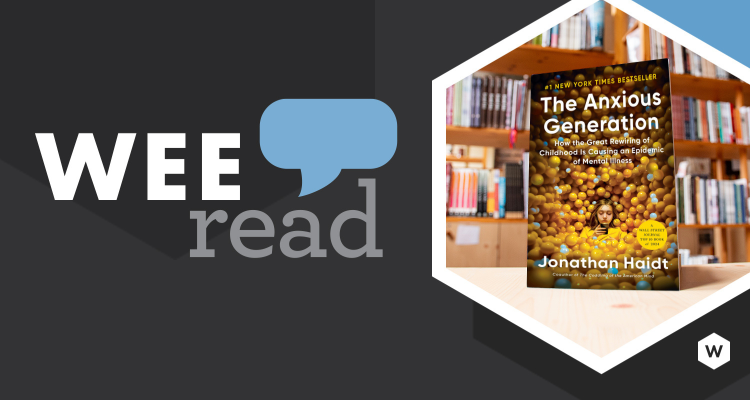
If you’ve ever thought “Society feels different. Kids are different. Parenting is different,” you’re not alone. Something is different. Things have changed, and there’s a reason behind it. Jonathan Haidt, the author of The Anxious Generation, explains this phenomenon as “the Great Rewiring.”
In his book [The Anxious Generation], Haidt goes into detail regarding what has happened to society and childhood with the advancements of technology and social media.
The Anxious Generation is an essential read for parents of all ages, anyone who works with children, or anyone who is curious about why a noticeable shift has occurred in society.

As a guest on the Good Inside Podcast with Dr. Becky Haidt explained that the older generation has always complained about technological advancements with the younger generation for as long as time can tell. For the majority of these instances, it has been “the boy who cried wolf.” Up until now, these cries and complaints were harmless, which caused us to think “this is just how the older generation responds to new technology.” Except now, the complaint is real. The wolf is here and the danger is substantial.
“This book tells the story of what happened to the generation born after 1995, popularly known as Gen Z, the generation that follows millennials (born 1981 to 1995)” (Haidt 2024 p. 5).
In the introduction to this book, Haidt explains that a phone based childhood is similar to growing up on Mars. Mars does not provide the life supporting elements that will help a child grow. In turn, Mars’ environment is harmful to child development.

Part 1: A Tidal wave
In the first section of his book, Haidt explores the surge of suffering that has occurred with the rise of a phone-based childhood as opposed to a play-based childhood.
Haidt refers to phones as “experience blockers” which made it difficult for children to explore the necessary societal experiences they needed from a play-based childhood.
Part 2: The Backstory
In this section of The Anxious Generation, Haidt explores the decline of the play-based childhood. There are certain elements of a play-based childhood that are necessary for child development. This section of the book also discusses the difference between discover mode (the behavioral activation system) and defend mode (the behavioral inhibition system), a key element to Haidt’s conversation.
“The two systems together form a mechanism for quickly adapting to changing conditions, like a thermostat that can activate either a heating system or a cooling system as the temperature fluctuates.” (Haidt, 2024 p. 69)
“For people with chronic anxiety, defend mode is chronically activated.” (Haidt 2024 p. 69)
Discover mode allows the brain to scan for opportunities. Conversely, defend mode has the brain scan for dangers.
Part 3: The Great Rewiring
In part 3, Haidt further breaks down the four foundational harms of a phone based childhood: social deprivation, sleep deprivation, attention fragmentation, and addiction.
“Henry David Thoreau wrote, ‘The cost of a thing is the amount of…life which is to be exchanged for it, immediately or in the long run.’ So what is the opportunity cost to children and adolescents when they started spending six, or eight, or perhaps even 16 hours each day interacting with their devices?” (Haidt 2024 p. 120).
Part 4: Collective Action For a Healthier Childhood
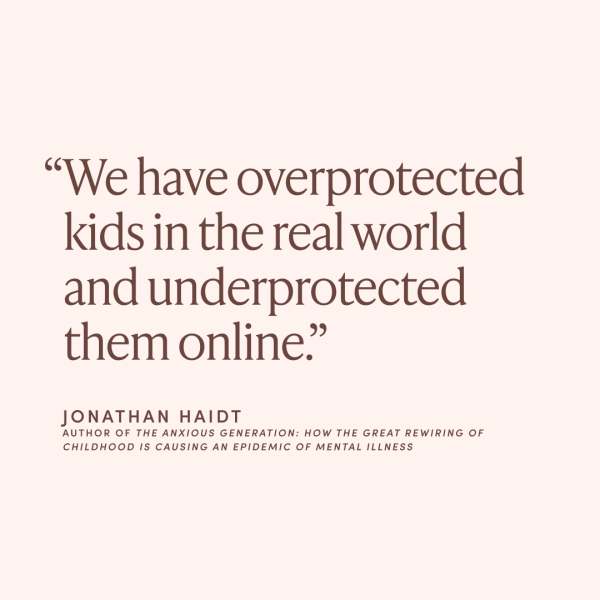
After discussing what has happened to create the Great Rewiring, Haidt offers practical solutions to combat the effects of a phone-based childhood. The solutions he offers require collective action among parents. The solutions he offers include a variety of ways to increase a play based childhood, support independence, and decrease time on devices.

In addition to The Anxious Generation, there is a kids version of the book titled “The Amazing Generation” which explores the ideas of his book in a more kid friendly way.
“I read this book in order to support my role as a school counselor, but I found out that this book benefitted me as a parent more than anything. This book really helps me reflect on how my own children, and the children I work with, were suffering from the use of technology, screen time, and social media in ways I didn’t understand. I also enjoyed the chapters that focused on the differences between the impact of social media on boys and girls.” – Allyson Kangisser, school counselor.
If any of this information piques your interest and you are curious to learn more about how much we have been affected by the evolution of technology and social media, I highly encourage you to read The Anxious Generation by Jonathon Haidt.