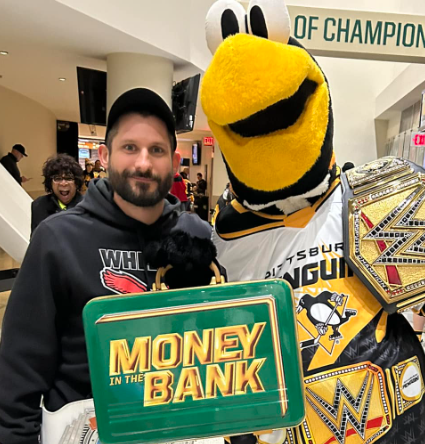

My name is Sean Calangelo, and I’ll be a guest writer here at Weelunk from time to time. I grew up in Wheeling and have always loved this city. After living in Pittsburgh for the last decade, my beautiful wife and I are now raising two daughters and have started to seriously consider a return to The Friendly City—it’s such a wonderful place to raise a family.
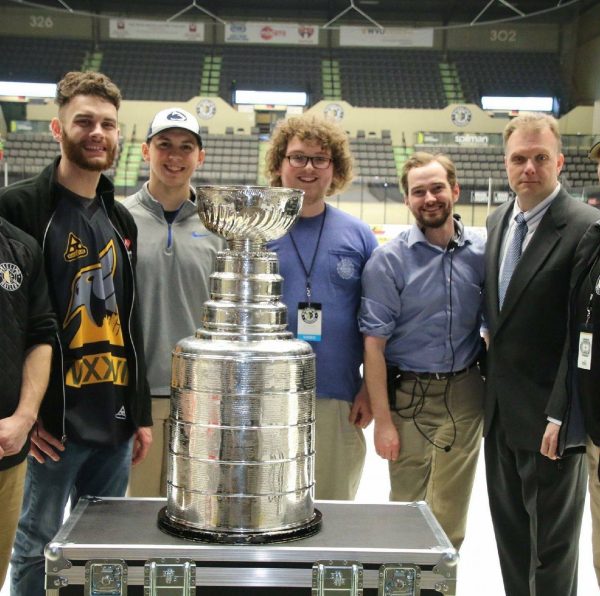
One of the perks of living in the ‘Burgh has been being so close to the Pittsburgh Penguins. I’ve attended dozens of games over the years and was fortunate to be here for their back-to-back Stanley Cup championships in 2016 and 2017. But as much as I love the Pens, Wheeling has quite a hockey history of its own, and it’s a story worth revisiting.

The Birth of Wheeling Hockey
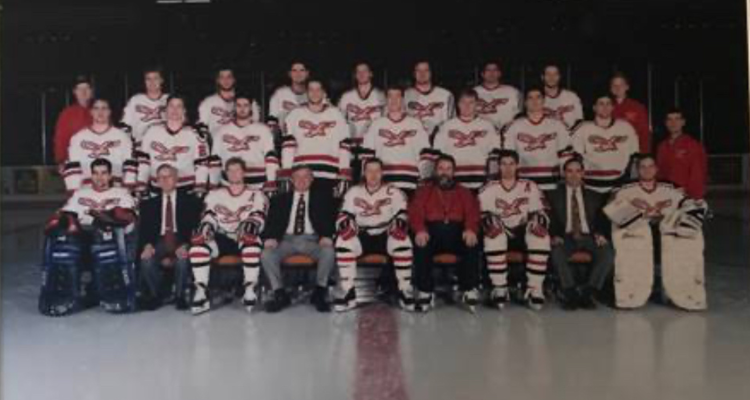
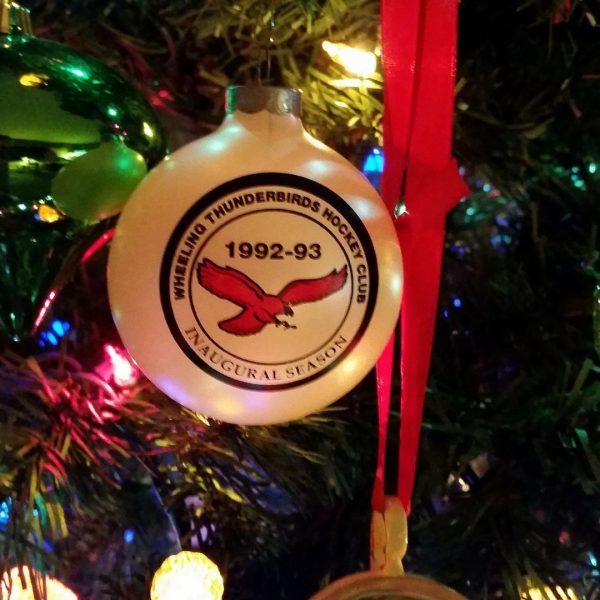
Before they were the Nailers, Wheeling’s hockey club had a brief but exciting run under a different name. From 1992 to 1996, they were known as the Wheeling Thunderbirds, a team born when the Winston-Salem Thunderbirds agreed to relocate to Wheeling in March 1992.
That summer, the first sheet of ice was laid at the Wheeling Civic Center (now WesBanco Arena), and just a few months later, Wheeling’s first professional hockey team hit the ice. On October 18, 1992, the Thunderbirds defeated the Dayton Bombers 9–3 in their inaugural regular-season game—marking the first win, first goal, and first hat trick in franchise history.
The T-Birds found success immediately, finishing first in the East with a 40-16-8 record and reaching the Riley Cup Finals in their debut season. Though they lost to the Toledo Storm, the team quickly captured Wheeling’s heart. Over the next three seasons, they posted three 40-win years and made multiple deep playoff runs. Despite never claiming the Riley Cup, the Thunderbirds’ strong start laid the foundation for a lasting hockey tradition in Wheeling.

Q&A with Dave Flatley, the Voice of Wheeling Hockey
Now, while I’m more than happy to recount the early days of professional hockey in Wheeling, I was in diapers at the time—so I didn’t exactly have my boots on the ground. To get a better sense of how it all started, I talked with Dave Flatley, who spent 30 years as the announcer for the Thunderbirds and Nailers.
Q: Dave, thanks for taking the time to talk. Thirty years behind the mic is quite the run—what was your favorite part about announcing games?
A: “Probably being around the players and off-ice officials. We had a lot of laughs and storytelling. The early staff was great too — I made life-long friendships with people like David Goucher, Mark Landini, Susie Nelson, Tonya Hunt, and Fred Traynor. We definitely learned some new sayings from the players…”[most of which aren’t exactly appropriate for Weelunk.]
The crowds early on were amazing. Players always say it’s fun to play in front of a big crowd, and it was the same for me. Announcing to about 5,000 fans every night in those first years was incredibly energizing.”
Q: You were there from the start. How did you get the job, and what was the atmosphere like when the team was first announced?
A: “The excitement was unreal. Season tickets sold fast —lines formed every day at the box office. Remember, this was before online ticketing.
I had been doing PA for Wheeling Park High School and the OVAC, and when hockey came to town, they held three exhibition games to audition announcers. Eleven of us tried out. Everyone split periods except me. They gave me a full game because of my experience.
That week, I was headed to Walt Disney World when Marty Nash called about the decision. After a few back-and-forth calls, he finally said, ‘You got the job— you need to be down here tomorrow night for rehearsals.’ I told him I’d be back Saturday and could start Sunday. They used a backup for the beginning of opening night, and I took over later. About halfway through the season, they told me, ‘We want you for all games from here on out.’ That’s how it started in the 1992-93 season.”
Q: The Thunderbirds’ red-and-black jerseys were iconic. Are you partial to the Thunderbirds or the Nailers name and logo?
A: “I was sad to see the Thunderbirds name go, but the Nailers really hit the jackpot with their logo. During the ‘Name the Team’ contest, the runner-up was the Wheeling Goal Miners, I actually liked that one too since it tied into the area’s coal-mining history.
But Wheeling-Pittsburgh Steel pushed for the Nailers concept, linking it to La Belle Iron Works, which made cut nails. That’s how the ‘Nail City’ nickname came to be. It goes back to around 1875.”
Q: What led to the name change?
A: “It was a Seattle team using a similar eagle logo. Ours was flipped the other way, but they called Wheeling out on it, and that led to the name-the-team contest. It created both excitement and backlash. Fans loved the Thunderbirds name and colors, and we lost several hundred season ticket holders because of it. People were pissed—nobody likes change!”
Q: When did the Penguins affiliation come into play? I’ve heard rumors that the team was once tied to both Montreal and Pittsburgh.
A: “That’s true. Once the Penguins came on board, Montreal stayed in the picture for a bit. That was thanks to long-standing NHL relationships Larry Kish had built over the years. Larry and Marty Nash both played huge roles when the team came to Wheeling. Sadly, both have passed away now. It makes you realize the business of life is really just the acquisition of memories. In the end, that’s all there is.”
Q: Who were the Thunderbirds’ biggest rivals, and which games stand out most?
A: “Dayton Bombers, Columbus Chill, and Johnstown Chiefs—those were the big ones. The ECHL was gritty back then — lots of fights — and those teams always brought the toughness. Toledo was another great rivalry; their coach Nick Vitucci loved our DiCarlo’s pizza. He’d come over before games asking if it was out yet. Just one of those memories that sticks.”

Q: Any favorite players?
A: “I liked just about all of them. Some early guys I’ve stayed in touch with include Brock Woods, Darren Schwartz, Vadim Slivchenko, and Terry Virtue. Hockey players really are some of the nicest people in sports—it’s how they’re raised. Everyone talks about the ‘hockey family,’ and it’s true. I only met a few who were standoffish or mean. Most were just genuinely good people.”
Q: Do you have a most memorable announcement from a Thunderbirds game?
A: “One night we were playing Columbus, and the Ohio River was rising fast. The arena staff had to shut down the sewer system mid-game, which meant no one could use the restrooms—including the players! I told Denny Magruder, the arena manager, that he could make that announcement. I introduced him, and all I could think of was the Christmas Vacation scene with Uncle Eddie yelling, ‘Sh***er’s full!’”
Q: Any other moments that stand out?
A: “One night, John Brophy, longtime coach of the Hampton Roads Admirals, came after me after a game, accusing me of running out the clock. He started walking across the ice toward the booth, pointing and yelling. I was yelling back and even spotted a broken stick in case I needed to defend myself! Thankfully it didn’t come to that.
Years later, when he became Wheeling’s coach, I asked if he remembered. He didn’t, but he was a much different Brophy after his car accident.
The two biggest promotional nights were when Mario Lemieux came to Wheeling—once for his bobblehead giveaway and once just to attend a game. We broke attendance records both times. When I introduced him, I played audio of Mike Lange’s goal calls over Tina Turner’s Simply the Best. About halfway through, Mario leaned over and said, ‘How long does this go on?’ I told him, ‘Just one more call.’ Then I gave my best John Barbero-style introduction. I hope I did him proud.”
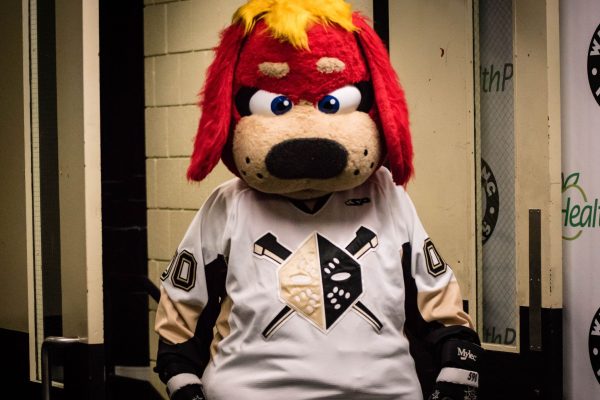
Q: And finally—who wins in a mascot fight, Spike or Bucky?
A: “Back in the day, Bucky probably would’ve taken it with his big body. But the newer, leaner Bucky? Spike probably wins that one every time.”
Looking Back
Thanks again to Dave for taking the time to answer my questions. Although he’s stepped away from the Nailers, he continues to announce games for Wheeling Park High School football and basketball—so be sure to listen for his great voice at those events.
As we celebrate 33 years since the Thunderbirds’ first puck drop on October 18, 1992, it’s clear that their story isn’t just about wins and losses, it’s about a community that found its team, and a legacy that still skates strong in The Friendly City.