

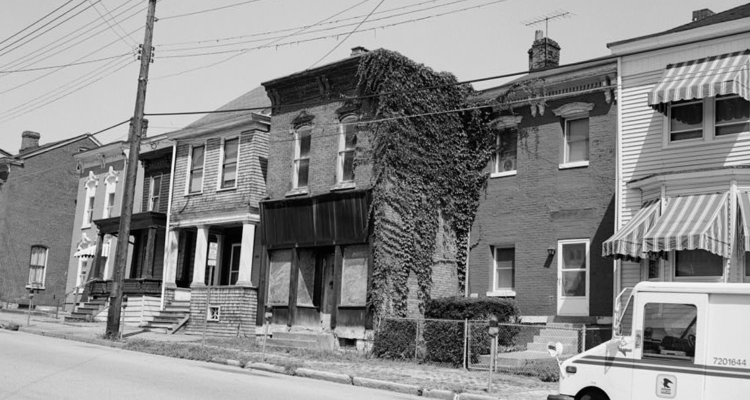
From preserved Victorian houses to the Suspension Bridge to the Ohio River, anyone driving, biking, or walking around Wheeling sees just how much history is constantly all around them. Hundreds of thousands of more fascinating stories can be discovered exploring the Ohio County Public Library Archives and Special Collections, poking around in antique shops, and even sitting around your neighbor’s dining table.
But what about Wheeling’s history that exists outside the bounds of the city?
Museums, libraries, and collections all over the country contain bits and pieces of Wheeling’s rich history. Some are included in institutions that collect and share the nation’s history while others end up in new places when someone from Wheeling moved or traveled away. While there are so many places to search for Wheeling’s history, here are a few examples from the Library of Congress to inspire your exploration:
U.S. Secret Service Photographs
The Secret Service in Wheeling? While most people think of the U.S. Secret Service as a law enforcement agency tasked with providing protection for the president and other political leaders, it actually started out as part of the Department of the Treasury. After the Civil War, the Secret Service was created with the main job of rooting out fraudsters and counterfeiters.
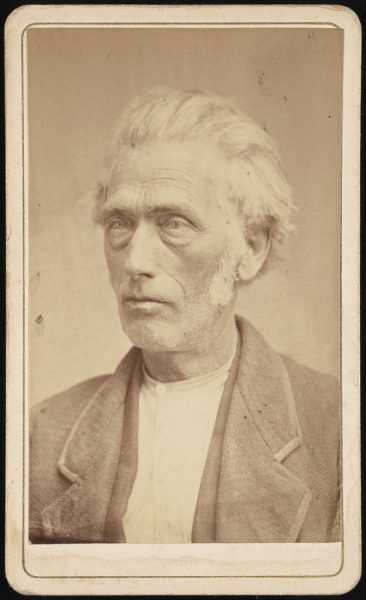
This photograph of James P. Freeland was taken at the popular J.A.H. Parsons’s photography studio on Market Street in Wheeling. Used to correctly identify and document wanted criminals, the photograph is part of the William Kennoch collection of U.S. Secret Service photographs. Freeland was part of a gang of counterfeiters operating out of West Virginia and other nearby states. After a sting operation exposed the counterfeiters in the act, Freeland was arrested in December 1876. He confessed to his crime and was eventually sentenced to one year’s imprisonment at the West Virginia Penitentiary in Moundsville, WV.
Popular Baseball Sheet Music: “Hit the Ball”
The Library of Congress contains over a century of materials—from books to music to maps—that people have registered for copyright. While the first federal copyright law was passed within a few years of officially becoming a country, the U.S. Copyright Office was created within the Library of Congress 107 years later.
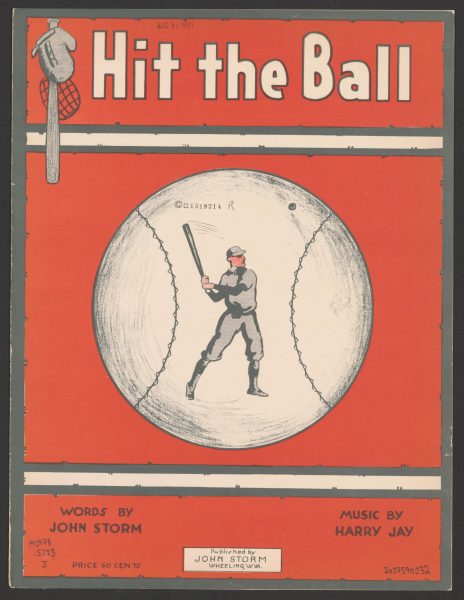
This sheet music for the 1921 song “Hit the Ball” is a great example of local Wheeling ending up in the largest library in the world. According to The Wheeling Register, John Storm was a streetcar “motorman” who moonlighted as a song-writer. In addition to finding inspiration in America’s favorite pastime, Storm lived in Benwood and also wrote songs with local themes like famous Ohio River floods in Wheeling and the state of West Virginia. Never a famous musician, John Storm and his music may have been lost to time if not for its preservation in the Library of Congress.
Historic American Buildings Survey Photographs
The Historic American Buildings Survey (or HABS) started in 1933 to survey and document the country’s architectural heritage. Founded as a partnership between the National Park Service, the Library of Congress, and the American Institute of Architects, the program has generated hundreds of thousands of publicly-accessible photographs of historic buildings around the country—including Wheeling.
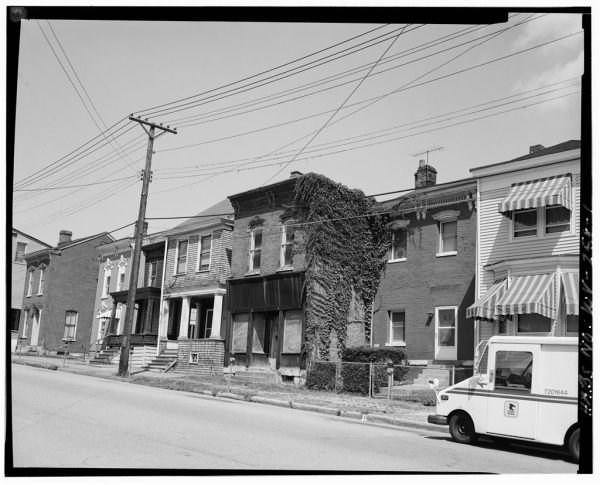
In exploring Wheeling’s history, it is also worth considering what is no longer visible. Even as many amazing buildings have been preserved around town, other buildings have been demolished for a variety of reasons. As years go on, the city changes and the neighborhood eventually forgets what was once there—HABS photographs can provide evidence of destruction. For example, this photograph of the William Mueller Store at 2242 Eoff Street depicts a full block—today, there is an empty lot where the c. 1860 Italianate vernacular brick building once stood. Was your favorite Wheeling building documented by HABS?
Wheeling Majority Newspaper
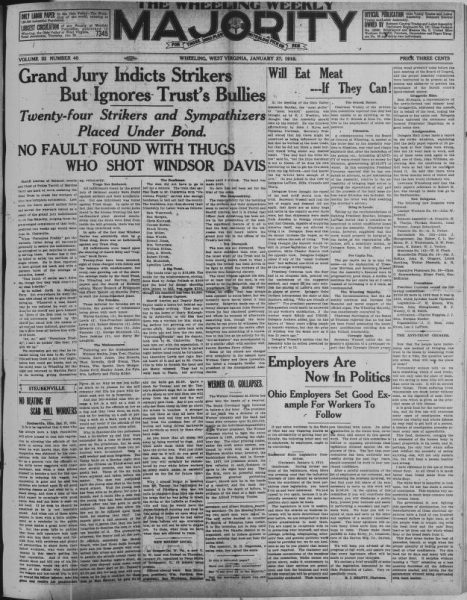
One of the most prolific sources of Wheeling history in other places are newspapers and periodicals. Designed to share information to people in places near and far, newspapers like the Wheeling Majority helped spread the word and news of the day.
With publication starting in 1907, the Wheeling Majority was Wheeling’s first labor newspaper and focused on news “For Those Who Plod With Plow or Pick or Pen”—at least as its motto claimed. At the start of the 20th century, many of the city’s residents (including children) worked in industrial or agricultural spaces. During this time, labor reform was a hot political conversation and included debates over the 8-hour workday, factory regulations, industrial safety measures, minimum age requirements, and more.
The first Red Scare and growing fear of socialism in the American labor movement brought the end to the Wheeling Majority and it published its last issue on April 29, 1920. While workplaces have greatly changed in Wheeling over the last century, you can explore how the fight for worker’s rights is evergreen through the digitized issues of the Wheeling Majority on the Library of Congress’s Chronicling America site.
The Sources are Endless
From counterfeit criminals to photographs of houses long gone, Wheeling’s significance in our nation’s history stretches from the banks of the Ohio River all the way to Washington, DC and beyond. The Library of Congress is certainly not the only place outside of the city to find traces and documentation of Wheeling’s history—just an example of the treasures available if one starts to look.
References:
“The Courts,” The Wheeling Daily Intelligencer, December 20, 1877, https://ohiocountywv.historyarchives.online/viewer?i=f&d=01011865-12311886&k=%22james%20p%20freeland%22&m=between&ord=k1&fn=wheeling_daily_intelligencer_usa_west_virginia_wheeling_18771220_english_4&df=1&dt=3.
“Flood Prods Song-Writer,” The Wheeling Register, May 7, 1933, https://ohiocountywv.historyarchives.online/viewer?i=f&d=01011910-01011950&k=%22john%20storm%22&m=between&ord=k1&fn=the_wheeling_sunday_register_usa_west_virginia_wheeling_19330507_english_34&df=1&dt=10.
“Historic American Buildings Survey,” National Park Service, Department of the Interior, September 20, 2023, https://www.nps.gov/subjects/heritagedocumentation/habs.htm.
“History of U.S. Copyright Office,” U.S. Copyright Office, https://www.copyright.gov/history/copyright-exhibit/history-co/.
“The “Kelt-Makers”: Breaking Up the West Virginia Gang of Counterfeiters,” The Wheeling Daily Register, September 19, 1877, https://ohiocountywv.historyarchives.online/viewer?i=f&d=01011865-12311886&k=%22freeland%22&m=between&ord=k1&fn=wheeling_daily_register_usa_west_virginia_wheeling_18770919_english_4&df=1&dt=10.
Steven Mintz, “Historical Context: The Post-World War I Red Scare,” The Gilder Lehrman Institute of American History, https://www.gilderlehrman.org/history-resources/teacher-resources/historical-context-post-world-war-i-red-scare.
“Timeline of Our History,” United States Secret Service, https://www.secretservice.gov/about/history/timeline.
Neely Tucker, “True Crime: William Kennoch, The Ace Counterfeit Detective,” Library of Congress, June 23, 2025, https://blogs.loc.gov/loc/2025/06/true-crime-william-kennoch-the-ace-counterfeit-detective/.
Kate Wietor, “The Rise and Fall of Wheeling’s First Labor Newspaper,” Weelunk, May 6, 2022, https://weelunk.com/rise-fall-wheelings-first-labor-newspaper/.
“Wheeling Majority (Wheeling, W.Va.) 1907-192?,” Library of Congress, https://www.loc.gov/item/sn86092530/.