

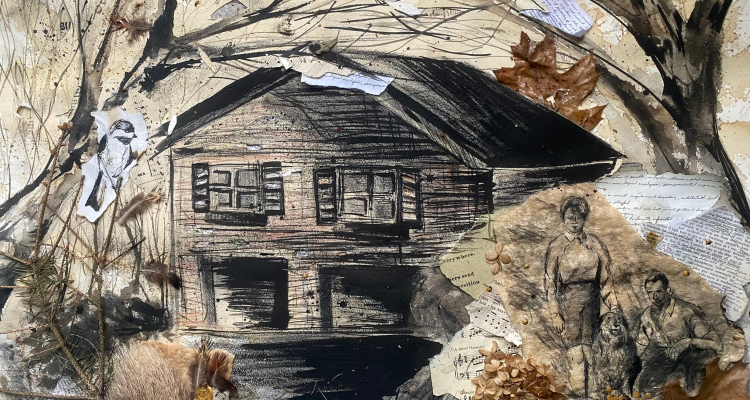
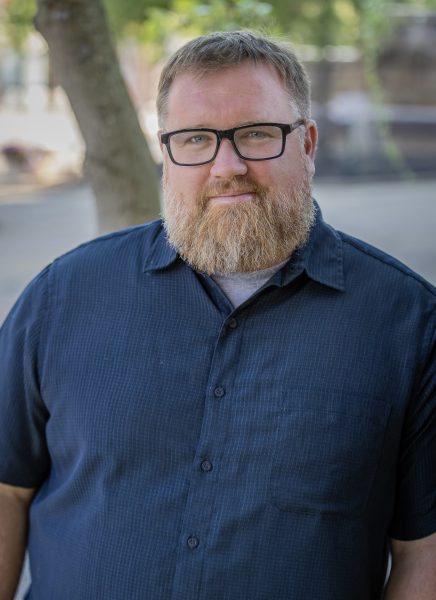
Just over the hill at West Liberty University, English Professor, Dr. W. Scott Hanna, is officially making debut this month with his poetry collection, The Only House on the Left.
Personal Life
Before becoming an English teacher, Hanna’s interest in poetry and literature goes far back. His father, introducing him to literary classics at a young age, was what he describes being very influential. So much, in fact, that he became an English Major. Then when he attended West Liberty as a student, he found himself in Dr. Dave Thomas’ poetry class.
“It was there that I began to understand the craft of poetry,” said Hanna. “So, I had always been writing since then, but it was not until much later after I finished my PhD that I began to focus more on creative writing than academic writing.”
An English professor at WLU for sixteen years, Hanna not only teaches Shakespeare and Creative Writing, but he is also the advisor for the student run Literary Journal,” Threshold,” as well as the coordinator for the “Hughes Lecture Series,” which brings various authors to speak at WLU. With all this, Hanna has still made time to focus on his own creative work.
Creating The Book
From October 2016 to December 2025, he has published 25 poems and creative nonfiction pieces in journals such as Porter House Review, Pine Mountain Sand and Gravel, Clever Magazine, and others in both online and print formats. After accumulating several publications, just a few years ago Hanna realized he had enough quality pieces to make a full collection, something he had in the works back while getting his PhD.
“It was a long process,” said Hanna. “I have been working toward completing this manuscript since finishing my PhD back in 2012, A few years ago, I finally felt as if I had enough quality pieces to make a full collection, and at that point, I started the process of revising and sequencing the pieces to achieve the effect that I was looking for collection. I put a lot of time and attention into the structure of the book as a whole so that readers can hopefully follow a kind of chronology if they decide to read it from cover to cover.”
Hanna also could not pick a favorite poem because he said they are all so different and represent such different ideas and stages of life. But the poems he is particularly proud of or attached to are the prologue, “Years of Gravity”, which can be found in the Porter House Review, and the long prose-poem “The Parable of the Boy and the Mountain”. He also couldn’t depict which of the poems would be a fan’s favorite.
“It’s hard to say about readers’ reactions because often the pieces that I think aren’t the greatest are the ones others think are really good,” said Hanna.
He describes the book as a memoir in verse, with poems following into five different sections. Starting with childhood, to coming-of-age, marriage, fatherhood, and then the challenges of grief after losing a parent.
“I haven’t set out to communicate any sort of message or lesson, but to just write poems about being human, and the very powerful ways that we can establish connections through family and a deep connection with place and the natural world,” said Hanna. “While the last section of the book does focus on loss and the grieving process, I do believe it ends on a note of healing and hopefulness—that we find healing with each other and with our connection to home.”
Family Connections
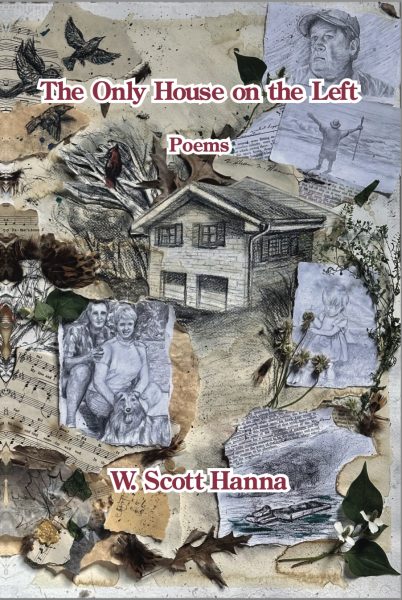
Ties with family relationships center the journal and continues outside of the texts with the cover art created by Katie Weir.
“The cover was done by my niece, Katie Weir, and it is stunning,” said Hanna,” I am so grateful for her work on it. As part of her senior thesis at Edinboro University several years ago, she did several illustrations of my writing, so I always knew that if I ever did finish a book, she would be the one to do the cover. She does these beautiful collages that combine illustrations, found objects, and techniques. Each image on the cover connects to the imagery in the poems. You’ll see illustrations of my parents, as well as images of my childhood home, and other images that connect to some of the nature and cultural references in the book.”
Many of Weir’s illustrations can be found on Hanna’s website, wscotthanna.com, under the “Illustration Gallery” tab. Each piece listed is inspired by the poems and prose found within the book.
The title of the book, The Only House on the Left, also continues the family themes.
“That is the house I was born and raised in off of GC&P Road on Dawn Ree Drive. It refers to when my dad would give directions to someone who was trying to find the house. In the neighborhood, there were four houses on one side of the private drive and one, ours, on the other,” said Hanna. “So, he would always refer to our house as ‘the only house on the left.’”
This house was more than just the house on the left. The nature and neighborhood had inspired Hanna into the poet he is now.
“It is more than just the house, it is the surrounding area, woods, and fields where I spent so much time as a kid,” said Hanna. “It was an idyllic place and neighborhood to grow up in, and it left an important and powerful impression on me. I think it laid a foundation for me as a poet as far as paying attention to the beauty of the natural world.”

Launch Party Coming Soon
On Saturday, February 14, The Only House on the Left, will make its debut. A launch event will be held the same day at the Urban Collective, a new event venue on Market Street in downtown Wheeling.
The event will be held from 5 – 7 p.m., with a live reading at 5:30. Not only that, but a book sale and signing will then follow, along with Weir’s artworks being shown throughout with prints for sale.
Stop by Urban Collective on February 14, for The Only House on the Left, or PURCHASE the book online through Kelsay Books and Amazon.
Poem Preview
And now, a look at the poem “The Only House on the Left”, following the nature and solitude of the childhood home after it has been left abandoned.
Forty years before
this brokenness,
before bed-riddenness
exchanged longing
for servitude,
before the silent midsummers on porches,
where you became monuments,
to time’s slowing and speeding,
and the coming on of that evening
light in august,
before knowing all that its passing
will take away,
the crabapple bloomed
white the spring of ‘74,
forsythia bursting
yellow on the hill,
green ground and wood
tugging at our guts even then,
pulling down,
swelling and pregnant,
memory digging in,
root, and leaf, and sky, turning
toward words
we would never end up saying,
always turning toward
the empty winter of now,
when cardinals croon in the pines,
chickadees burrow in the yews,
bare-branched maple and locust thatch
against gray November dream skies
and the light in the back woods,
falls finally in morning,
silvering the frosted grass,
and later in evening,
lays the pine shadows out
long across the east field
by the empty house
where no eyes or voice or body,
or even memory
is left to bear witness.